Hunting and Wildlife Magazine - Issue 229 - Winter 2025
Words By: Gwyn Thurlow
May 1925 marks a significant, but little-known centenary in New Zealand’s alpine hunting story: it marks 100 years since a special warrant was issued to shoot the first chamois and tahr in the Southern Alps.
Granted by the Minister for Internal Affairs, the permit authorised Mr R. L. Wigley of the Mount Cook Motor Company to shoot Himalayan tahr and alpine chamois in the mountains surrounding the Hermitage at Mount Cook. These animals were to be taxidermied and exhibited in the Tourist Department’s display at the 1925–26 New Zealand and South Seas International Exhibition in Dunedin.
It was the first time either species had been lawfully hunted in New Zealand. Until then, both species, introduced two decades earlier, remained fully protected. This act marks the beginning of what would become a uniquely New Zealand alpine hunting tradition.
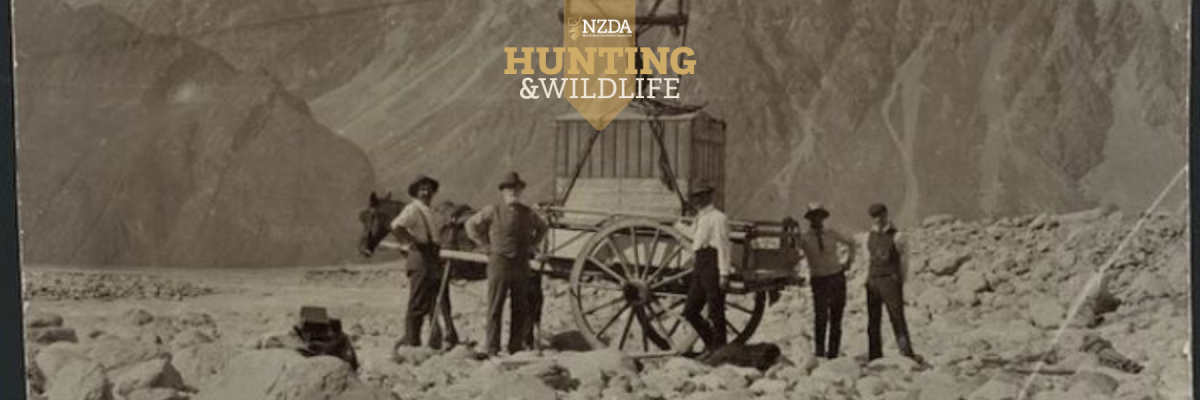
By way of background, the Himalayan tahr was the first of the two alpine species to arrive. In 1904, six animals were gifted by the Duke of Bedford. They were released in the Sealy Range behind Mount Cook village, just above the Hermitage. The hope was that they would establish a self-sustaining population and provide future sporting opportunities. Three years later, in March 1907, a consignment of eight chamois arrived at the Hermitage from the European Alps. These animals had been gifted by the Emperor of Austria as part of a diplomatic exchange involving kea and kiwi, and had been captured and shipped from the Emperor’s hunting grounds in the faraway Austrian Alps. A quarantine waiver was obtained to expedite their release, and in mid-to-late March, they were ferried by cable cage across the Hooker River and released at the base of Mount Wakefield.

Newspaper reporting at the time noted:
’Mr McDonald, who is in charge of the Hermitage, gives a graphic account of the liberation of the chamois... With a slightly bewildered look they scanned their surroundings, and, apparently recognising something familiar in the steep mountain side beside them, they made two or three quick jumps into the air, and fled with lightning speed up the nearest spur.’
Despite early doubts, the chamois quickly adapted to their new terrain. Sightings of young animals were recorded within a year. By 1910, the Tourist Department's official annual reports noted that the herd appeared to be breeding successfully. Word of their progress reached Europe, and soon a telegraph cable sent from Vienna in 1910 reported:
‘The Emperor Francis Josef visited the International Shooting Sports Exhibition in Vienna. His first inquiry in the British section was respecting the chamois deer which he had presented to New Zealand.’
In 1913, the Emperor issued an imperial command to send a second consignment of chamois. After difficulties sourcing wild animals, it seems that three semi-tamed chamois from the Schönbrunn Menagerie (zoo) were shipped. One, a doe, died en route and the remaining two were too frail to continue and were rested in Melbourne Zoo. After recovery, they were sent to Christchurch and quarantined on Quail Island. On 28 May 1914, the two chamois, a young buck and doe, were released in the same area as the original 1907 liberation, near the Hooker River suspension bridge. The buck remained in the vicinity and, having grown too accustomed to human interaction, became aggressive. In January 1915, a local guide was forced to dispatch the buck using an alpenstock after a tussle near Ball Hut.
By this time, however, the wider chamois herd was thriving. A 1917 report noted a group of 20 chamois near Franz Josef. In 1919, a herd of 70 was observed. By 1921, the established population was estimated at over 100 animals. Range expansion was evident, with animals being recorded in the Copland Valley, across the Main Divide, and as far north as Arthur’s Pass by 1927.
It was noted that, initially, the tahr seemed to be more elusive and less successful at breeding and range expansion than the chamois. As we know now, tahr have a more limited range than chamois, which have populated all the mountains along the South Island.
Until 1925, hunting tahr or chamois was strictly prohibited by law. However, that year, with the Dunedin Exhibition approaching, the Tourist Department sought to showcase the country's unique fauna and big game hunting opportunities. The Department arranged for Mr Wigley to collect representative trophies of tahr and chamois for the government display. Special ministerial permission was required, and a formal warrant was issued.
Newspaper reports provide a detailed and factual record of the hunt:
‘Recently Mr R. L. Wigley was requested by the Dunedin Exhibition management to secure specimens of thar and chamois that are to be found on the mountains at the back of the Mount Cook Hermitage. On his first expedition, Mr Wigley bagged a fine thar, but did not get within range of any chamois. On Sunday, however, he was fortunate in securing two fine chamois on the upper slopes of the Wakefield Range, at the back of the Hermitage.’
The article goes on to describe the size and condition of the animals:
‘Both animals were splendidly proportioned, the larger turning the scale at 93 pounds, and being two feet six inches in height, while its horns were ten inches in length. On these dimensions the chamois must have thrived wonderfully, for the heaviest animal shot in Austria... weighed 82 pounds... The two chamois secured by Mr Wigley are the first that have been shot in the Dominion.’
The animals were placed in cold storage at Smithfield Freezing Works, then transferred to taxidermist F. S. Steffan in Oamaru. Steffan, a Tyrolese alpine guide by background, completed full-body mounts. The finished trophies were installed in the Tourist Department's display in November 1925.
‘An exhibit which is attracting more than usual attention... is a group of mounted chamois and a thar... Mr Steffan states that they are exceptionally fine specimens, being considerably heavier than the average chamois of the same age in Austria. They are handsome animals and the stalking of them in their native haunts requires considerable agility and nerve.’
This hunt, its authorisation, and the public display that followed confirmed the transition of tahr and chamois from protected introductions, to recognised, trophy-worthy alpine game.
The formal declaration of an open season followed five years later. In May 1930, three licences were issued to hunt chamois and tahr—two animals per licence—at a cost of £10 each. That figure, adjusted for inflation, equates to around NZ$1300 today. The system was administered by local acclimatation societies, with strict limits on location and species.
A report in The New Zealand Fishing and Shooting Gazette (April 1929) stated:
‘During May next there will be an open season for chamois and thar... Six thar were presented by the Duke of Bedford in 1904, and were released at Mount Cook. The first draft of eight chamois were turned out in 1907. These were presented by the Emperor of Austria... Both types have spread along the main divide, north and south, and also across the West Coast via Copland Pass.’
So, 1930 marks the start of legal public access to New Zealand’s alpine big game.
As I have a personal passion for alpine hunting and the history of tahr and chamois, in May 2025, a full century after Mr Wigley’s hunt, I stood with my family at the Hooker River, near the cable cage site where the first chamois were released. I stayed at the modern-day Hermitage Hotel and looked up the creeks where the first tahr made their home in the bluffs. Looking up at the mountains, I could see the very same terrain where the first legal hunts for these animals occurred. That moment, and the research that led me to it, was the culmination of years of research and interest in the origins of our alpine hunting heritage.

A hundred years on from the first legal hunt of chamois and tahr, the opportunity is still there—just as real, just as rewarding. These animals were brought here for a reason, and they’ve earned their place in our alpine landscape and in our hunting culture. If you haven’t hunted them yet, get into it. There’s no better way to see our backcountry, test yourself, and take part in something that’s been going on for a century.
Accompanying this article are period images, including early pictures of the first tahr and chamois shot in New Zealand, and archival photos of the 1925 Exhibition mounts. These materials are published here to preserve the record, and to mark 100 years since the first legal alpine hunt in New Zealand.
Read Hunting & Wildlife Magazine
NZDA members receive an electronic version by email, and can access it on the NZDA app. Subscriptions and physical copies can be purchased online. Visit the NZDA Shop at www.nzda.shop

Missed an issue?
We make our older editions free to read online. Browse the back catalogue here.
Write for Hunting and Wildlife