Hunting and Wildlife Magazine - Issue 233 - Summer 2026
Words by: John Taylor
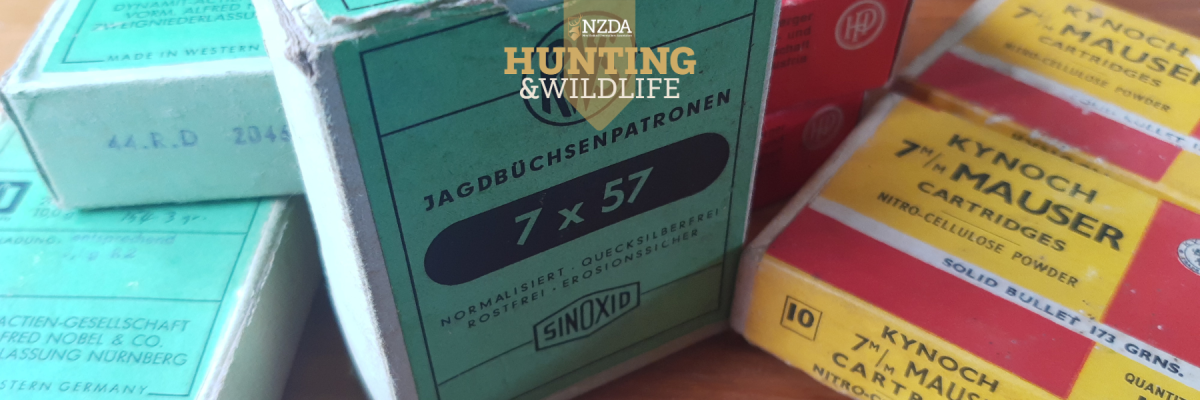
7x57 Mauser

Released: 1892
Calibre: .284 (7mm)
Cartridge Length: 3.065 Inches (77.85)
Case length: 2.235 Inches (56.77mm)
Capacity H20: 59.7
Primer: Large Rifle
Over the last few years, gun stores across the country have seen an increasing number of second-hand rifles chambered for 7x57 coming onto the market. These are generally Mauser-action rifles made by various legendary British manufacturers, BSA and Parker Hale, as well as European manufacturers like BRNO, FN, Husqvarna, and, of course, converted World War Two-era German 98Ks.
Looking at the posts on various hunting and shooting forums, most are dismissive of this cartridge, claiming it is long dead.
Looking through magazines from the 80s, you could still see advertisements for new rifles chambered for 7x57. It was quoted in various well-respected New Zealand hunting books as one of a handful of cartridges that were perfect for local game animals. Then, seemingly overnight, the cartridge disappeared from new chambering lists. Ammunition supplies shrank to a trickle, and even regular supplies of brass for handloading became difficult to source.
Let's take a look at the history of this fantastic and almost forgotten cartridge.
History
The 7x57, otherwise known as the 7mm Mauser or, in Britain, the .275 Rigby, was developed by Mauser in 1892. It was designed as a military round and was initially chambered only experimentally in some Mauser 1892-pattern rifles. It is simply Mauser’s even older 8x57 cartridge necked down to take a 7mm projectile. In 1893, Mauser released its improved pattern rifle, chambered in 7x57. These Model 93 rifles were sold to Spain and subsequently to other European and Latin American countries.
While chamberings differed from country to country, the Spanish adopted the cartridge with a 173-grain round-nose full metal jacket (FMJ) projectile. The rifle had a relatively fast 1:8.75 twist and a 24-inch barrel. This gave a muzzle velocity of around 2300 fps, delivering just over 2000 ft/lbs of energy. The heavy-for-calibre projectile has a very high sectional density, which promotes good penetration despite the relatively slow velocity by today's standards.
The cartridge really came to prominence in the Spanish-American War of 1898. US troops were using Krag Rifles chambered in 30-40 Krag, a cartridge generally thought to be slightly less capable than the British .303. Like the .303, the 30-40 Krag is a rimmed cartridge and exhibited the same feed problems in the bolt-action Krag rifle that the British experienced with their Enfields. The Krag was also a relatively weak action, on par with early Lee Enfields. The Mauser was a superior design, stronger and firing a rimless case that allowed for faster and more reliable loading and chambering. The US troops were badly mauled in several battles, putting this down to the superior cartridge and rifles of the Spanish forces. As a result, the US would go on to develop the classic Springfield 1903 rifle, effectively a Mauser action, and its own classic cartridge, the 30-06, which was controversially based on Mauser’s cartridge. This blatant theft of intellectual property caused considerable animosity between Germany and the USA at the time.
As with most military cartridges, the 7x57 cartridge was also finding favour with hunters. In England, Rigby was building their classic lightweight stalking rifles on imported German flat-top Mauser actions. Rigby decided that selling London's best rifles, chambered in a German cartridge, was not acceptable from a marketing standpoint, so they procured a licence from Mauser for the cartridge and renamed it the .275 Rigby.
They were exactly the same cartridge, but it was perhaps an early example of the marketing nonsense that seems to pervade the firearms industry to this very day.
Performance out of proportion to its size
Probably the single most famous user of the 7x57 cartridge was WDM Bell. Bell was from Scotland and made his fortune by shooting elephants for ivory in the then-largely unexplored East Africa.
There were plenty of people hunting ivory in the early 1900s, but what set Bell apart from them is that he, by his own account, shot over 1,000 elephants using predominantly just a light-weight Rigby Mauser action stalking rifle, chambered in .275 Rigby. He used standard 7x57, 173-grain military round-nose ball ammunition. In the harsh East African environment, he found it far more reliable than the commercial sporting ammunition of the day.
Bell liked the cartridge because it had relatively low recoil, was relatively flat-shooting, and was sufficiently accurate to enable him to brain-shoot his animals. He not only dispatched elephants with the cartridge, but he has also recorded shooting large numbers of smaller game for camp meat, as well as the occasional buffalo and lion.
Bell was a superb shot, and many who tried to replicate his feat died as a result.
Any cartridge with mild recoil, good accuracy and effective terminal performance is going to be a hit with hunters. The cartridge became extremely popular, particularly in European nations and their colonies and still is.
In British Empire nations, the rifle found favour with those wanting an alternative rifle to the ubiquitous .303 Lee Enfield, and British arms manufacturers began making sporting guns for the general market in various alternative calibres. Well-known makers such as BSA and Parker Hale, produced Mauser-action rifles that were imported into New Zealand in large numbers, with BSA generally considered of superior quality.
The cartridge failed to make much of an impact in America, with shooters there devoted to the mighty 30-06 and its derivatives, and this played a significant role in the 7x57’s demise.
In New Zealand, the cartridge was highlighted in Matt and Bruce Grant’s classic book The Sharpshooter, with pictures of Matt shooting a pre-WWII Oberndorf-manufactured sporting rifle chambered in 7x57mm.
Acknowledging the cartridge's popularity internationally, if not at home, American ammunition manufacturers were producing loads for it. Owing to the litigious nature of the industry in the US and the huge range of surplus rifles available after WWII in various models and quality levels, loads were kept rather anaemic compared to ammunition loaded by European companies.
There were quite a few relatively weak Remington Rolling Blocks chambered for 7x57 in America, and they could not handle maximum-power loads designed for the far stronger Mauser 98 actions and their modern commercial derivatives.
The Demise of the 7x57 Mauser
From the moment the .308 Winchester was released to the civilian market in 1952, people started necking down the cartridge to see what better performance they could get from the case. It was only natural that someone should try a 7mm projectile in the case. They found they could easily replicate the performance of the 7x57 cartridge in a smaller case.
Some 30 years later, in 1982, Remington finally formalised the cartridge and released the 7mm-08.
Before Hornady's spectacular marketing campaign to convince us all that the 6.5 Creedmoor was the greatest cartridge ever developed, the 7mm-08 was the default option that gun shops in New Zealand in the 1990s and 2000s would recommend to new shooters.
Coincidental to the rise in popularity of the 7mm-08 was the collapse of the British firearms manufacturing sector. First, BSA and then Parker Hale shut up shop; other companies, such as Churchill and Midlands, also closed during this period. Leaving no Commonwealth manufacturers of what I would call a working man's centrefire rifle in the market.
America, and to a lesser extent Europe, became the only places to get reasonably priced firearms, and the Americans chambered their guns in 7mm-08 in preference to the 7x57. That might be a bit of a generalisation, as Remington, Winchester and Ruger did chamber rifles in 7x57 for a while, but they were a rarity.
SAKO, Tikka, and Sauer followed, offering rifles in 7mm-08 for sale in the USA and, from there, worldwide.
The 7x57 was forgotten in the rush to adopt the new cartridge.
Loading the 7x57 today
To get the best from the cartridge, New Zealand hunters had to handload. For many years, there was still plenty of brass around for those who continued to use the calibre, but over time, as demand dropped, so did supply. Recently, Norma seems to be the only manufacturer of 7x57 brass being imported, with the occasional packet of Sellier & Bellot showing up.
In a modern rifle, the 7x57 has the potential to equal the performance of the 7mm-08. The performance of the 7mm-08 is due to its smaller combustion chamber and much higher operating pressures. The SAAMI-mandated maximum pressure for the 7mm-08 is 52,000 psi, while the 7x57 is only 46,000 psi.
In a strong, modern rifle, the 7x57 cartridge is capable of operating at pressures equal to those of the more modern 7mm-08, and of matching its velocities with the same powders. It must be conceded, though, that the 7mm-08 is a more efficient design, as it generally uses less powder to achieve the same velocities.
With modern projectiles, over modern powder, and in a good rifle, the cartridge is capable of exceptional accuracy. Good powders are in the AR2208 and AR2209. The 7x57 can be loaded with projectile weights similar to those of the 7mm-08. In my rifle, 150gr ELD-Xs perform well.
No Brass No Problem
One of the great advantages of the 7x57 case design is that, despite the poor availability of brass, it is easily formed from the far more common and equally classic 30-06 case.
To create a case, simply remove the expander rod from your 7x57 full-length sizing die, lube the 30-06 case and run it into the die. Trim the case to the correct length. Reinstall the expander rod and run the trimmed case back into the full-length sizing die. Recheck your overall length, trim and taper ream the mouth and you have a 7x57 case ready to load. Easy.
A word of caution, though, if you also own a 30-06 rifle, make sure you mark your new 7x57 cases in some way to avoid accidental chambering in your 30-06. A bit of red permanent marker in the extraction groove or over the primer should be sufficient.
Conclusion
The 7x57 deserves to be celebrated as a classic hunting cartridge. If you have the opportunity to pick up a sporting rifle chambered for this cartridge, you will find it on par with the 7mm-08 in every respect. With careful loading, it is more than capable of handling every game animal available to New Zealand hunters.
This scrappy South Wairarapa Stag was taken in 2025 with a rifle manufactured in 1959 and a cartridge designed in 1892.
Think about that the next time your local gun shop tries to convince you to upgrade your rifle.
Read Hunting & Wildlife Magazine
NZDA members receive an electronic version by email, and can access it on the NZDA app. Subscriptions and physical copies can be purchased online. Visit the NZDA Shop at www.nzda.shop

Missed an issue?
We make our older editions free to read online. Browse the back catalogue here.
Write for Hunting and Wildlife