Hunting and Wildlife Magazine - Issue 228 - Autumn 2025
Words By: Stu Langslow
I was sitting at my mother-in-law's, a five-hour drive from home, watching my two-year-old and newborn play on the floor. I was daydreaming of being in the hills, when I felt my phone vibrating. It was a call from my good mate Mark. I answered, and he breathlessly asked what I was doing at the end of March, because he had a plan for a hunting trip. I could tell from the emotion in his voice that he was super excited about the prospect of the private access to public conservation land that he had managed to wrangle. So without asking the wife (dangerous, I know), I asked what dates I needed to be at his house. I started looking at flights, and within an hour, I had booked, and a rough plan was starting to take shape. Now I only had to wait the near six months till I hopped on the plane.
Come February, I was in talks with a company about upending my cruisey lifestyle in Taranaki and moving to the Waikato. So, in the middle of moving regions, I disappeared for a week into the mountains. Some might think this isn’t such a great idea, and I tend to agree, but adventure was calling…
After catching several flights to Nelson, we met for a last-minute packing and map-studying session. We got our heads down at about 2.00am, ready for the seven days ahead. Waking up and being on the road by 9.00am was a tough ask. Still, it wasn’t long after that we were on the road, expecting to be at the parking spot around lunchtime. When one of the main routes from the east coast through to the west coast was closed for roadworks, we were delayed by several hours and had to find another way across, arriving mid-afternoon.
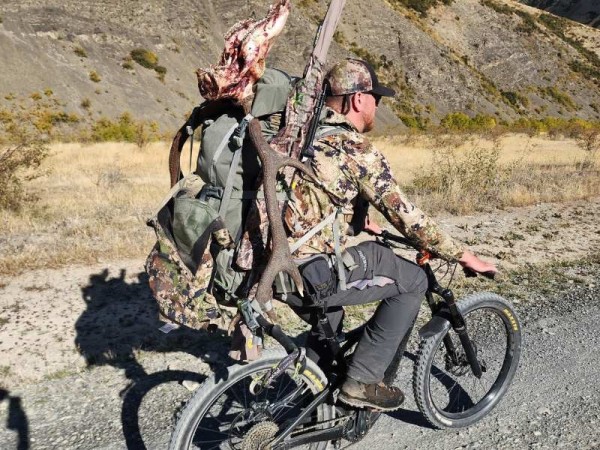
The first 18-20kms of the journey was to be on mountain bikes. I hadn’t ridden a bike for years and was totally unprepared for the mind-numbing pain caused by carrying a 25kg packand riding over the corrugations in the road over that first hour and a half. During one of my frequent breaks to rest my ‘seat’, we noticed a helicopter that looked to be checking out all the valleys for something. Once we got closer, we saw that they were spraying wilding pines. This didn’t exactly fill us with confidence as it appeared they had been travelling over the area we were headed into.
Once we stashed the bikes and started the next trek into DOC land, we kept our eyes peeled for an easy deer. Over the next eight kms, we had multiple run-ins with pigs and piglets, which didn’t interest me at all but they were cool to see. Just as we were getting close to where we had planned to camp for the night, we rounded a corner to see another tent set up. What a nightmare to find someone already in the area we had planned to explore. After waking the sleeping Austrian, we discovered he had walked the long way and was planning on heading over into the catchment beyond where we were. We continued up the valley until dark and found a spot to camp for the night. By this stage, we still hadn’t seen any deer or heard any roars.
Day 2: We woke to frozen boots and a good amount of ice inside and outside our tents.
As we were packing up, our new Austrian friend caught up with us, and we discussed boundaries and the areas we were all heading into.
Stashing half of our food supply in a location near the end of the loop we were aiming to do over the next few days, we prepared for a huge climb up to the main ridgeline. We ended up walking right up to the end of one of the main catchments and up to one of the main saddles in the blazing sun. We had aimed to try to hit the last creek to fill up our water bladders, but unfortunately, it was dry. This inspired a discussion about whether it was easier to sidle up the valley with minimal water, or to drop our heavy packs, and drop down to fill up water bladders without packs. In the end, this is what we were forced to do—fill up as much water as we could with the intention of spending as much time on the tops as we could.
Once we reached the main ridge, we started walking along it, glassing and looking for a campsite for the night. By this time, the wind had picked up, which made setting the tents up on the exposed ridge a slight challenge, but we got it done with enough time spare to get an evening glassing session in before dark, with some likely looking terrain below. This was when we finally started picking up a few deer and the faint echo of roars. However, it wasn’t long before a couple of mature stags we had spotted packed up their hinds and headed over several valleys, and we were left to cook dinner in the dark.
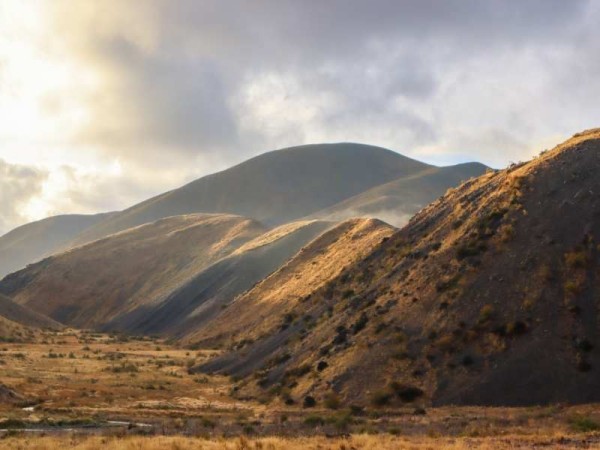
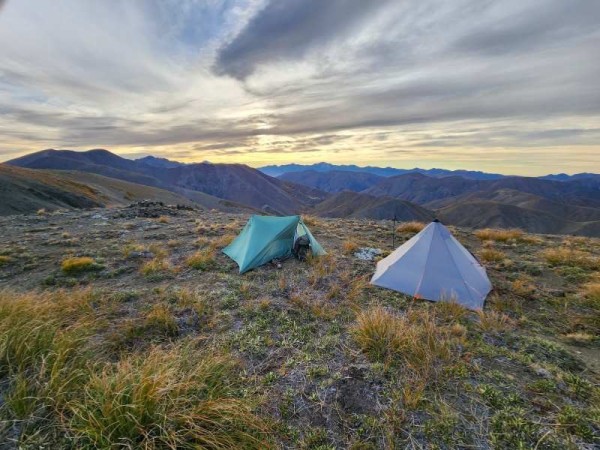
Day 3: As soon as it was light enough to glass, we ran down to where we had been the previous night. After about an hour of glassing and only turning up a few spikers and hinds, we headed back to camp for breakfast. I then popped over one of the spurs from the main ridge and spotted a stag All I saw at first was a lot of bright white points, so hurriedly, I got down and set up my rifle and camera to film the shot. It wasn’t long before I started to calm down and realised it may not be as big as I first thought, and after a quick discussion with Mark, we made the decision to leave him for another year. Most of the day was spent lying in the sun, glassing, and trying to spot new stags. The sun was brutal, and the cold morning of the second day was long gone - just like our water stocks. At approximately 4.00pm, we made the decision to drop down to the valley floor and head up to where we had seen one of the mature stags go the night before.
On one of our stops to glass on the way down, we thought we heard a gunshot, and we watched about 20 hinds and spikers run off into the distance at great speed. Once at the bottom, we headed up in the direction of the gunshot we thought we had heard, stopping and sitting on a mound looking up a side creek. We started to pick up deer we hadn’t seen before and heard multiple deer roaring, so we decided to sit and wait to see what came out. Soon, we picked up a young six-point stag, with several hinds, making its way towards us. This is when we realised we had made a big mistake and were sitting in full view of everything up the side creek, so, slowly when the young stag and hinds weren’t looking, we had to move to the other side of the mound, out of sight. Every now and then, we heard another roar, which would catch the attention of the young six-pointer as he continued towards us, eventually making his way within 40 metres and in full view of us.
Once the small stag and his hinds had walked past, we could have a better look at the side creek for something more mature. It wasn’t long before the stag we had heard walked out, just long enough for us to get the spotter on him and assess him as a mature 11 or 12 pointer. As he walked in and out of folds chasing hinds around, I decided he was a shooter, so as he made his way closer, we had time to set ourselves up and wait for a decent shot. It wasn’t long before he offered a shot at around 350 metres, and Mark’s 7mm PRC sent an ELD-M projectile straight into the big stag's chest. It lurched forward and kicked up a cloud of dust as it dove downhill, running out of sight into a large patch of rosehip.
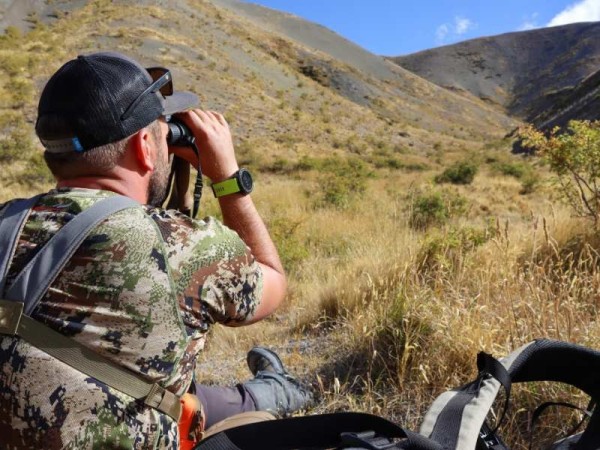
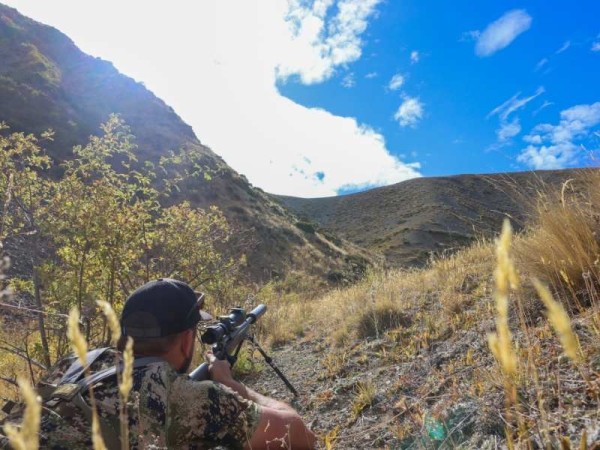
After the congratulatory high-fives, we grabbed our stuff and made our way up to where we saw the stag disappear. It didn’t take long before we found him, and making my way through the rosehip, trying to minimise the damage to my skin, I lifted the solid 11-point antlers after freeing them from the shrub they were firmly stuck in. With the light fading, we quickly dragged him down to a flat area for the obligatory photos, which really showed the mass of his body.
After the photo and butchery session, we packed up and headed back to our packs, which had just become significantly heavier. Making our way up the main valley in the dark, we searched for a campsite and collapsed after a huge day full of ups and downs.
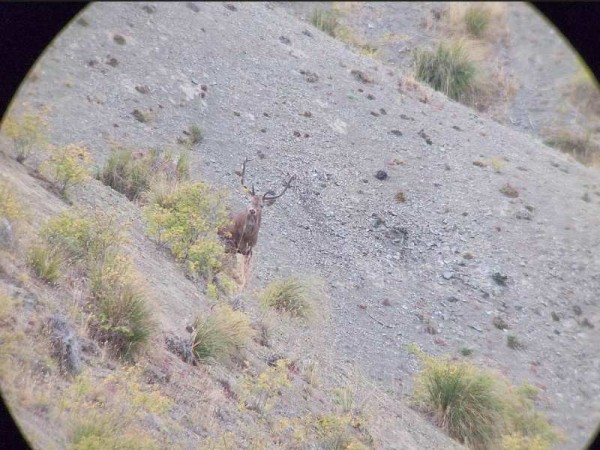
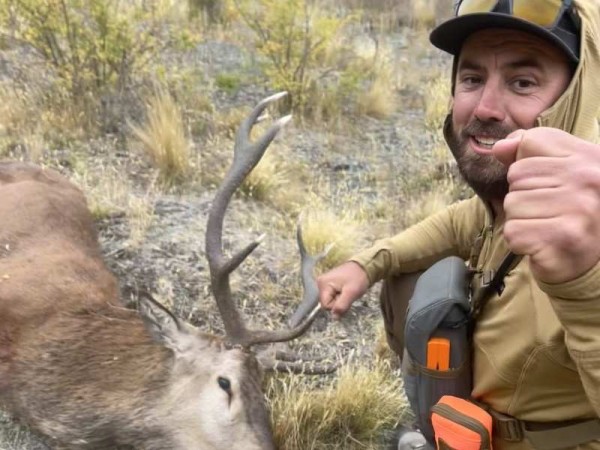
Day 4: called for a slow morning start, glassing from camp while we dried out some gear in the morning sun. We glassed back up the valley in some of the deep side creeks, hoping to spot an animal we hadn’t already seen. After a couple of slow hours, not picking much up, we slowly packed up and started heading down the main valley, checking the side creeks for anything of interest. We were finding many young six- and eight-point stags. Almost back to where we had stashed our supplies a few days earlier, we picked up a group of six hinds and two spikers, and after watching them for a few minutes, we picked up another animal sitting in some scrub. Since we could see antlers in our binoculars, this animal warranted getting the spotter out for further investigation.
Watching the big 11- or 12-pointer at around 1,300 metres, we spent the next hour deciding if we should go after him. As it was Mark's turn on the rifle, it was his decision. We decided that he was likely to be a middle-aged stag and probably a good one to let breed since he had brow tines, where a lot of the stags we had seen in the area were missing them. In hindsight, watching some footage of him on a bigger screen, he was probably a little bit older than we thought.
Continuing our walk back to the supply stash, we stopped near a bend in the river for some lunch and soon heard a helicopter approaching, heading straight overhead to where we had just come from. We could see the big stag and his hinds run for the bush edge. Our lunch break was soon interrupted by thunder in the distance and a few big drops of rain, so, quickly packing up, we raced off the river flats to find a suitable campsite away from the river. Finding a suitable campsite, I quickly set up the tents while Mark ran up the saddle to grab our supplies, so we could hide from the weather with some comfort.
After a couple of hours, the rain eased off to a level where we felt comfortable putting rain jackets on and heading up the hill behind camp to gain elevation, and check out some new country to explore over the coming days. Over the last few hours of daylight, we picked up a few boars and a few spikers in the distance, but nothing that really got us excited about heading up the valley further. We returned to camp at sunset with great views and discussed our plans for the next few days.
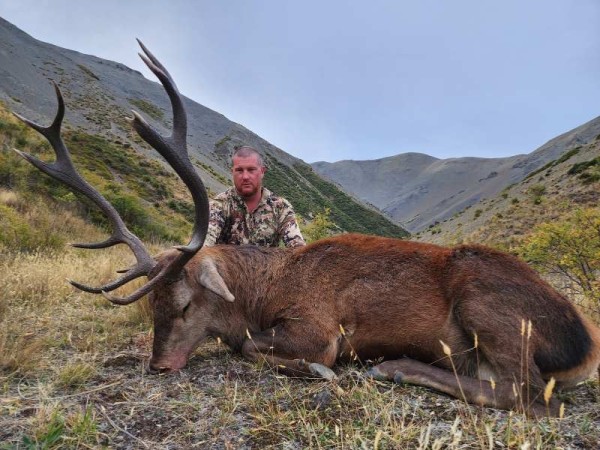
Day 5: We woke to a damp morning that soon turned to blistering heat. We packed up and tried to dry some gear, deciding to hunt our way back to the truck and try another spot over the next few days before I was due to fly home. Climbing up and out of the catchment, we found a few groups of hinds with no stags, which seemed weird for the area as we hadn’t seen any hinds without stags or at least spikers hanging around. The walkout was HOT! About 3 kms from the truck, Mark reminded me about several beers I had stashed, which gave me the motivation to put some pep in my step and get back despite the heavy antlers on top of my pack.
Read Hunting & Wildlife Magazine
NZDA members receive an electronic version by email, and can access it on the NZDA app. Subscriptions and physical copies can be purchased online. Visit the NZDA Shop at www.nzda.shop
Missed an issue?
We make our older editions free to read online. Browse the back catalogue here.
Write for Hunting and Wildlife

Join NZDA To Help Us Advocate on Your Behalf