Hunting and Wildlife Magazine - Issue 228 - Autumn 2025
Words By: Gwyn Thurlow
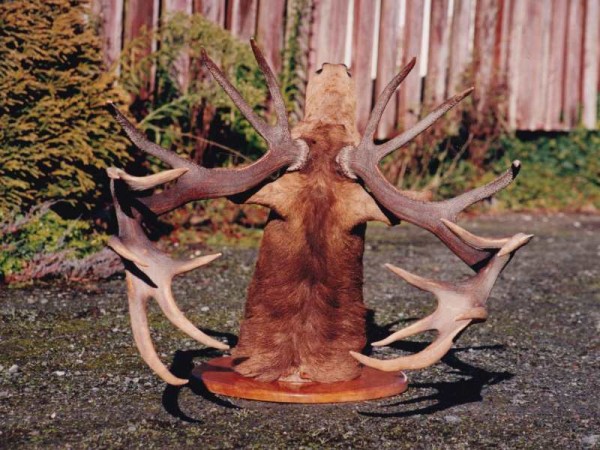
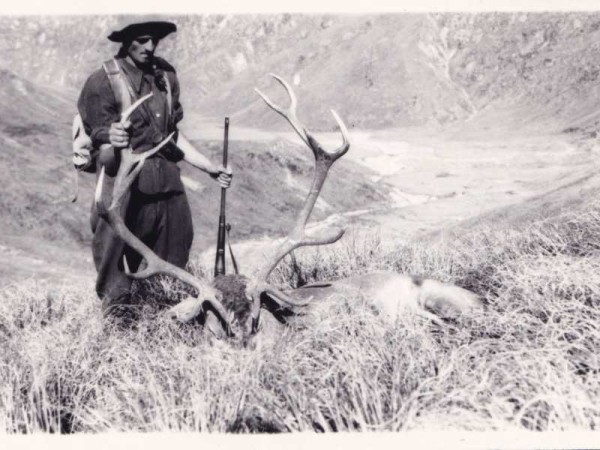 The museum at Deerstalkers House in Wellington has added a significant piece of New Zealand hunting history to its collection: the 18-point Otago Highland red stag head taken by J.A. ‘Ian’ McLeod in South Westland’s MacFarlane Valley on 30 March 1924.
Shot with a Ross .280 rifle—a Canadian-designed firearm known for its straight-pull bolt and precision—this trophy scored an exceptional 394 ¾ DS, earning a gold medal at the 1978 Exhibition of Hunting. The stag, with its 42 ¼-inch length, 36 ¾-inch spread, and 5 ¾-inch beam, represents a pinnacle of South Westland’s early 20th-century deer herds.
Recently presented to the NZDA Heritage Trust, the mounted head arrived with the original Ross .280 rifle, a photo album documenting the hunt and others from that era, and the 1978 gold medal, entrusted to us by McLeod’s successors after a century of private stewardship.
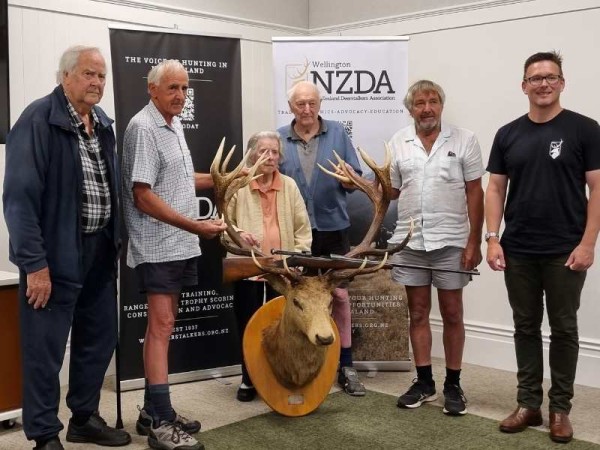
It was also a special moment when members of the McLeod clan joined the museum's official opening on 14 February, and had the chance to see this magnificent head in place, and given the prime spot that such a trophy deserves. The family were delighted, to say the least. As both a museum and a group committed to preserving hunting’s legacy, the New Zealand Deerstalkers Association is honoured to serve as custodians of this remarkable set. The placement of these items with NZDA underscores our mission to safeguard the stories and artifacts of New Zealand’s hunting past, for future generations.
Now, 100 years after McLeod’s shot rang out, the trophy and rifle stand together in our newly opened exhibit at Deerstalkers House; a public space where members and visitors can appreciate their historical weight.
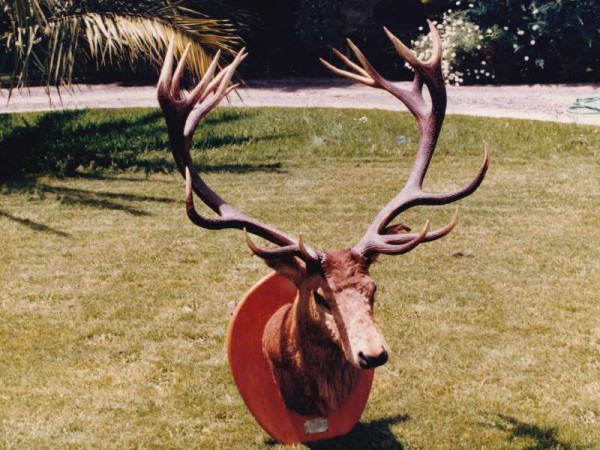
Our research uncovered McLeod’s firsthand account in the 1 July, 1930, New Zealand Fishing and Shooting Gazette, under the title ‘My Best Stag’. That article, reprinted below, details the challenging stalk on Birch Knob and the teamwork with famous deerstalker Archie Kitto that secured the trophy. Accompanying it are some photographs of the head as it appears today, with the Ross .280 on display in the gunroom.
“MY BEST STAG”
From ‘The New Zealand Fishing and Shooting Gazette’, 1 July, 1930, under the title of "My Best Stag", J. A. ’Ian’ McLeod relates the story of the taking of his magnificent 18-pointer in the MacFarlane Valley.
Hunter: J. A. McLeod. Shot 30 March 1924.
Locality: South Westland.
Length, 42 1/4in; Spread, 36 3/4 in; Beam, 5 3/4 in; Tip to Tip, 28 5/8 in.
DS 394 ¾
In 1923 my friend, A. D. Kitto and I, stalked the Wanaka West Country in the Lakes District of Otago. Our packing was done by that hard, wise and excellent old packer, Davy McLennan. Around the campfire of an evening, our talk was, as was natural, of stags and stag country. We came to the conclusion that the heads, in Wanaka West were deteriorating, and to obtain a "super" head we must seek pastures new. Davy was full of information, about South Westland, as he had trapped rabbits on the Haast and Landsborough flats, and he felt sure that good heads were there, if someone would go for them. A. D. Kitto had been at Makarora the year Captain Carlyon shot his wonderful Royal, in the Haast Valley, and he too was keen on South Westland. To make a long story short we decided, that providing we could get licenses, for South Westland we would go there next year (1924) and engaged Davy, to pack us in. We had no trouble with the licenses (South Westland was a Novus Terrae in those days and not rushed like it is now). Davy met us with a big team of horses at Makarora and we set out for the Burke Hut and the lands of our hopes and dreams.
From full and complete information we had received from Major R. Wilson and Mr. J. Forbes we had no trouble in locating our block and soon had a good base camp up, on the fringe of the bush, quite close to the Landsborough River, at the big ford.
Our party numbered four. J. M. Ross, F. M. Kitto, A. D. Kitto and myself. We did a bit of poking about the flats for a couple of days to get our lungs and legs in good condition for the big climbing which we knew was to come, but soon grew tired of the inaction.
So we set sail one fine morning, crossed the Clarke River and climbed to the top of the bush, near the Birch Knob. Our packs were heavy and we decided to camp at the top of the bush, and not make the first day too solid.
Next morning we climbed to the top of the ridge and obtained our first view of the McFarlane Valley. The lower portion of this valley is rough and gorgy, and may be negotiated by good climbers, but the best route is undoubtedly via the Birch Knob. The upper portion of the valley consists of good flats, surrounded by beech bush, while the head of the stream opens out into a fine big well grassed basin with large side streams running into it.
We travelled down hill and up stream from where we topped the ridge, stalking en route a good 15 point stag which A. D. Kitto shot. Length 431 inches, spread 381 inches, a heavy topped head with tremendous bay tines, one of which measured 17 inches in length.
Our trip had commenced, auspiciously, and my hopes were high as mine was the next stag.
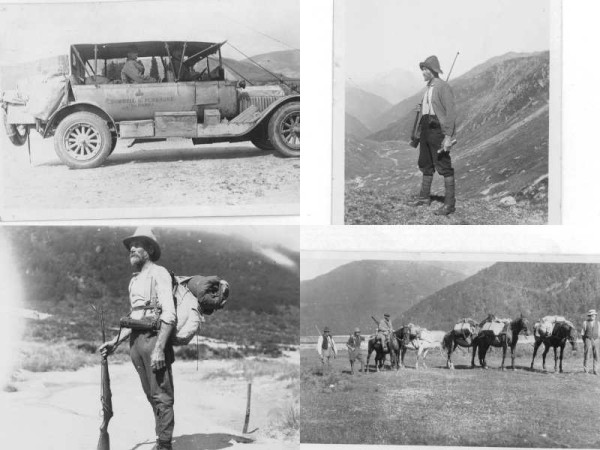
We climbed down into the bed of the McFarlane, very rough trip and A had a bad time with his 15 point head, as we got bluffed on several occasions. He left the head there as he had had enough of it, and we continued to scramble up the rocks in the bed of the river. We at last arrived in the open a few hundred yards from the big flats, and here decided to camp for the night. Needless to say we slept like logs after a day which was one long scramble.
Next morning was foggy and wet and Mr. Kitto and I agreed that our best plan would be to return to base for more provisions as a flood or a heavy fall of snow might lock us in the basin and land us in queer street. However. A. would have none of it, and would not turn back without examining the flats above us, which were really too close to ignore. We ended up in compromise, deciding to follow up to the flats, but return by midday. We would then cross the river and set off back to base-camp in the afternoon with the intention of arriving there the following day.
We started off upstream and just before reaching the flats, heard the roar of a stag, I took the rifle from Archie, as he had been carrying it up until that time. The roar was a weak one, but we stepped very warily. On rounding a corner in the beech forest, which was growing right down to the river's edge, we sighted a couple of hundred yards away, several hinds and calves. Archie spotted a stag rubbing his antlers on mountain ribbonwoods and quickly had the telescope on him. In the meantime, the hinds must have observed some movement from us, causing them to walk towards us, not in the least perturbed by our presence. The stag, attracted by the hind's movement, also moved towards us, the breeze being in our favour. They appeared t to have no fear, probably never having encountered a human being before.
The stag appeared to me to be a common enough fellow, his antlers appearing to be narrow, but through the fog one could not read his points. His antlers appeared to be fairly heavy. However, Archie insisted I shoot him, whispering in my ear that he was nearly as good as his 19-pointer and to take him quickly.
By this time the stag was only about 120 yards off standing chest on and peering over a toi toi bush at us, presenting a rather nasty shot. The toi toi was obscuring his chest. However, I fired four shots at him through the bush and as far as I could see, all he did was lift one front leg as if to stamp his foot. By the time my rifle was empty of cartridges, I felt disgusted to think I could not shoot straight. The hinds by this time had cleared off and as the stag stood still, I thought I must have at least hit him hard, else why was he just standing there. However, Archie, struck dumb at what had happened, rushed back four or five paces to his father, grabbed his rifle and just as the stag wheeled to gallop off, let fly with a beautiful shot, the stag crumpling up in a heap.
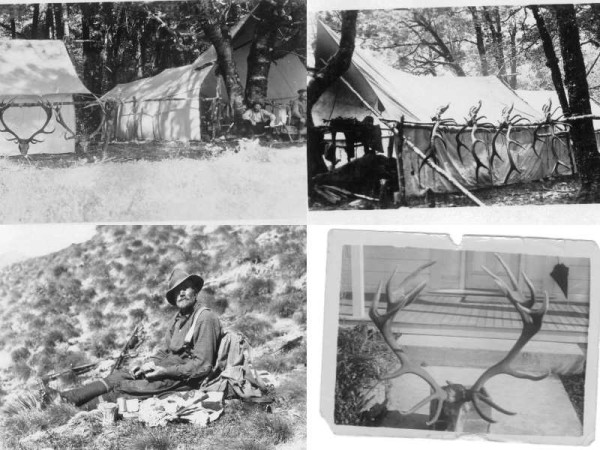
On examination I found to my great delight that one of the shots of the fusillade had torn the muscles of both a front and and hind leg on the sa same side and the shock of the bullet, no doubt, had caused the stag stand still for such a long period of time.
The fact that I had hit the stag first made him my trophy, but I was rather annoyed to think that I had made such a poor exhibition of the shooting and had not Archie crumpled him up with his well directed shot, I might well have never had this tale to tell.
The trophy carried 18 points, six beautiful ones on each top. The length was 42 inches, the spread 36 inches and a beam of 5 3/4 inches. It weighed 23 lbs.
My ambition had been to secure a trophy with a larger number of points than was usual and I had taken this fellow in a rather remarkable fashion. As Archie later said, we would wear out a lot of boot leather before we would get a better pair of trophies than the two heads we had secured in those two days spent in the MacFarlane Valley.
[It was an old Highland Scottish tradition that he who draws first blood is entitled to the stag. As far as I can discover, this tradition dates back to the days when the Highlands were a separate identity and prior to the Anglo-Saxon influence of the Lowlands of Scotland. It has been accepted by both English and foreign sportsmen to the Highlands as part and partial to the hunting rules and traditions and has probably spread to many other countries since, including those which owe their origins to British colonialism – [Note by D. Bruce Banwell]
Read Hunting & Wildlife Magazine
NZDA members receive an electronic version by email, and can access it on the NZDA app. Subscriptions and physical copies can be purchased online. Visit the NZDA Shop at www.nzda.shop
Missed an issue?
We make our older editions free to read online. Browse the back catalogue here.
Write for Hunting and Wildlife

Join NZDA To Help Us Advocate on Your Behalf