Hunting and Wildlife Magazine - Issue 228 - Autumn 2025 (read online now)
Words By: Hugh Devereux-Mack
Now that I had the right gear and could get it all set up on a range, my goal was to become a hunter rather than just a range shooter. As such, I needed to get out into the field and put my new-found knowledge and gear to the test. An opportunity arose in November, when two members of the Wellington Branch had a space in the car for a West Coast mission for tahr and chamois.
After a day of work, I met my two hunting partners for an 8.00pm ferry from Wellington. We took advantage of our NZDA member discount to book the truck and cabin overnight, to catch three hours’ sleep, before the longest day ahead. Arriving in Picton at midnight, we started the seven-hour drive, taking shifts of two hours each to keep us safely on the road throughout the night. It was the sort of trip you do when you’re young and… ‘enthusiastic’, but not a strategy we would repeat. However, it ensured we spent the most time in the hills possible.
The gear:
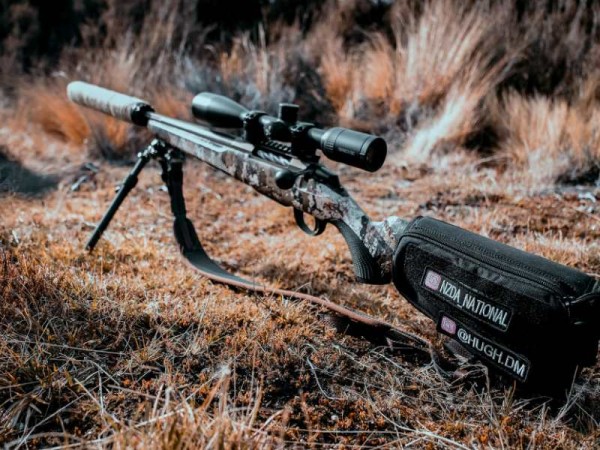
Before considering the hunt, the gear I used was incredibly relevant to the story, so here is a summary of the key pieces. Given this was a walk-in hunt with 10 days’ worth of food and equipment, weight would be a serious factor to consider. Although I would consider myself fit and had been training for this, an unforeseen accident the day before the trip meant I had to make some tough calls.
Pack
I accepted the offer to review the Hunters Element Arete 75L pack and frame with the StealthSHELL fabric during this hunt. Given that I weigh in at around 65kg, this was a decent size that would force me to be efficient with my packing choices. It also had some features that my regular hiking pack did not. These included external padded pockets for quick-access items like my first aid kit and spotting scope, 16 pockets to organise gear, and the inbuilt scabbard that runs down the spine to stash my rifle for the long walk. The scabbard is a real benefit, as it helps keep the balance of the pack even, and it’s a straightforward process when you need to take the rifle out.
What is interesting about the pack is that the frame and pack are two separate pieces that slot together. This allows the frame to be used with smaller 45L or 25L packs, for overnight or day hunts. They also have a meat shelf that fits between the frame and bag, which helps distribute the weight closer to your back. It’s a nice idea, but I found that it works best with their game bags—without which, securing the back legs or skin you are carrying home can be very frustrating. Also, when you are tired and in a hurry at last light, the number of straps can be frustrating to set up. I highly recommend watching the online tutorial and practising it at home a few times before trying to deploy it in the field.
The 75L pack does work well as a day bag when you empty it at your campsite, and, it is easier to clean when you can remove the frame from the bag. I like the bag but would not use it for an extended multi-day walking trip. Even when adequately fastened, I found that the pack section did ‘slosh’ around more when fully loaded than traditional integrated hiking-style packs, but that is a personal preference.
Base layer
I also ran the new Eclipse Vantage Hoodie V2 from Hunters Element, which I’ve now used on several hunts. This is their latest base layer, which they wanted feedback on after developing their V1. It is now my favourite summer base layer for a couple of reasons. Most importantly, it was designed for summer hunting, which means dealing with sweat and the subsequent smell, and helping to keep you cool when the sun is out.
They use their trademarked Hydrafuse Helios fabric technology, which is lightweight, breathable, and fast drying. After living in it for six days, thanks to the bamboo charcoal-infused fibres, the smell was not a factor for me, or more importantly, for the non-hunters we were sharing huts with. It also had long sleeves with UPF 30+ sun protection all around. The sleeves have done away with the thumbhole fasteners—a point of failure on the previous version—and are open enough that they can be rolled up should you want to keep the blood off them when processing animals. The hood was good to keep the sun off my neck and ears when glassing, and the integrated face veil, although a little tight, was great to keep the bugs off my face in the evenings.
Hiking poles
I have never been a big user of hiking poles, but I am glad I picked up a pair in a Macpac sale. Mine are nothing fancy, but the Macpac A3 Trekking Poles for $59 were a lifesaver. Recent studies indicate that hiking poles help you walk faster while feeling as though walking is easier. This is because you take loading off your leg muscles (a relevant point to this story), and improve balance with a heavy pack.
11 hours of pain
Arriving at the car park hours later, we geared up for what would feel like the longest walk of my life, though it should have only been seven hours. A key factor was that less than 48 hours before the trip, I had an unfortunate accident that, unknown to me at the time, had done more damage than was apparent.
As we set off on the walk, everything was fine, and the training I had put in was paying off, despite the heavier pack.... until a third of the way in. I slipped and landed awkwardly as the track transitioned from path to slippery-river boulders, and my left leg just jarred and collapsed on me. Later, I would learn I had partially torn my hip flexor, knee, and Achilles, though the doctor missed that before clearing me for the trip. After resting and popping good painkillers, I did not want to let the team down, so I put my head down and trudged on. We arrived at the campsite late, and the following morning, I realised that I couldn’t join my friends on the hunt, as I needed to recover enough to walk out 10 days later. This dream trip had turned into a nightmare, lying in camp for two days, barely able to walk, being molested by sandflies in the heat of a tent, and questioning every life decision that led me here. I repeated, “I’m happy my friends get to go hunting,” to overcome the disappointment, and it partially worked.
First chamois
On the third day, I had recovered enough to walk a short distance and take photos since I couldn’t hunt. I let the hut warden know my plan and when I expected to be back, then set off on the main track headed for a side creek that he said would be easy-going. As I was glassing from the track, I saw my first chamois 400m away, meandering across the gut, and decided it was worth making the climb.
Stalking slowly up the river and around the boulders, quietly moving closer while keeping it in sight, the adrenaline must have hit because my leg was not a problem. This was no longer a photo-gathering walk; it was my first solo big-game hunt and a real test of everything I had learned. Knowing my ballistics were good to 300m, I needed to close the distance before the chamois moved out of the area, and into the bush on either side of the creek I was in.
Unfortunately, by the time I had reached my selected shooting position, the animal was gone. I took a moment to acknowledge it would be unbelievable to successfully stalk my first chamois while others may go years without a chance. I was happy with my approach and don’t think I could have done anything differently given the situation.
So, I found a nice position to look over the valley next to some glacial pools, and rest. The area looked like a highway for animals with plenty of sign around, so I settled in to enjoy not being in camp. As midday approached, the heat was getting to me, and given there were no sandflies around, I took the opportunity to strip down and take a bath in one of the pools to clean off the last four days.
Keep your rifle close
Before the trip, NZDA Life Member Dulcie Riley gave me some advice that I will never forget—especially after this trip. Our many readers will have heard before, “No matter what you are doing, keep your rifle close and ready because an animal will appear at the moment you least expect it.”
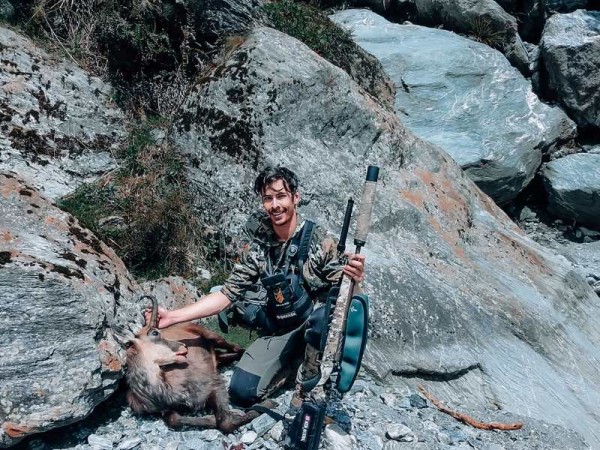
As I was taking a bath, a flicker of movement caught my eye, and I looked up to see a chamois buck moving across the stream uphill from me. Struggling to contain my disbelief, I grabbed my binoculars and ranged the shot: 210 metres—easily within range. I slowly grabbed the rifle and leaned against the boulder, settling my MTNGear Mountain bipod into place, dialling in 17 clicks, just as it stepped behind a bush and waited… and waited. About 10 minutes passed, and then I saw it pop up between two boulders, staring directly at me. I quickly ranged it again, 180m, took a breath to steady my excitement and fired at the centre of the chest. I heard the bullet strike and watched the animal stagger a little closer before turning slowly to hop back into the bush. My second shot went into the shoulder pocket, and it rolled off the boulder, leaving no doubt it was over.
Hands shaking with the excitement of my first chamois, I could not help but laugh at how ridiculous and memorable this situation was. Here I was, alone on a hill, as naked as the day I was born, with my clothes scattered on the rocks around me, and I had put down my first chamois. It was a truly unforgettable experience.
I dressed quickly and made my way up to the animal, knowing I had work to do. My issue was that I had never seen a chamois in real life, let alone up close, so I was unsure if it was a good one or not. Working in the NZDA office, I had seen the mounted ones, but it was hard to compare those to the one I now had at my feet. I didn’t care about the trophy nature of it; I was there for the steaks and the legs to break up the dehydrated meal plan we were on. But I took the head anyway because it was my first, and I was proud of the effort, even if it wasn’t the largest animal.
I met up with the others in my party that evening when they returned from clambering around the terrain my leg would not allow. When I saw them, I subtly asked how their day was and whether ’we got a couple of chamois today’. I was happy to hear they had successfully shot one and brought back meat, but they missed the implication of my use of the word ‘we’. It was not their fault as they’d had a much harder hunt than I did, so the tiredness was showing.
When I said that I had also taken a walk and found some success, I was rewarded with a satisfying look of surprise from them both. I indicated that my head was in the tree and they should take a look because I didn’t know if it was good or not. My satisfaction hit a peak when Matt said, “Jesus, you gammy b*stard, how the !*c&# did you get that…? It’s much bigger than our one,” which given the circumstances was a funny choice of words. I told them that all I had to do was take a bit of a walk, strip down, and wait. Simple.
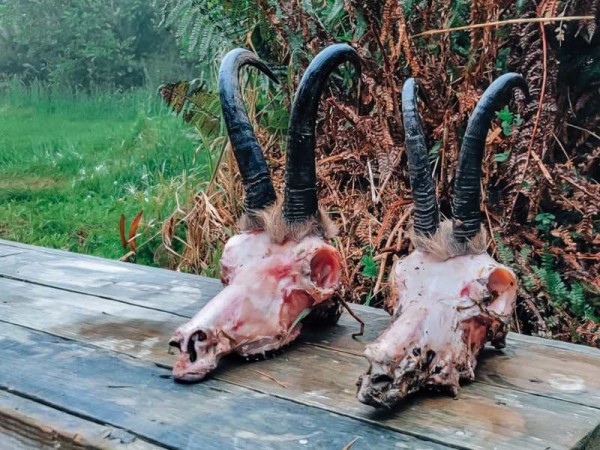
It wasn’t until a month later that we thought of running a measuring tape over it and found it measured nine and ¼ inches with good bases—a very respectable first animal and one that will soon be euro-mounted on my wall. In hindsight, I regret not taking the head skin; however, given the next day's events, I don’t think I would have managed the walk home if I had to carry two skins—but that’s a story for the next edition!
Read Hunting & Wildlife Magazine
NZDA members receive an electronic version by email, and can access it on the NZDA app. Subscriptions and physical copies can be purchased online. Visit the NZDA Shop at www.nzda.shop
Missed an issue?
We make our older editions free to read online. Browse the back catalogue here.
Write for Hunting and Wildlife
Join NZDA To Help Us Advocate on Your Behalf