Hunting and Wildlife Magazine - Issue 229 - Winter 2025
Words by: Mike Spray
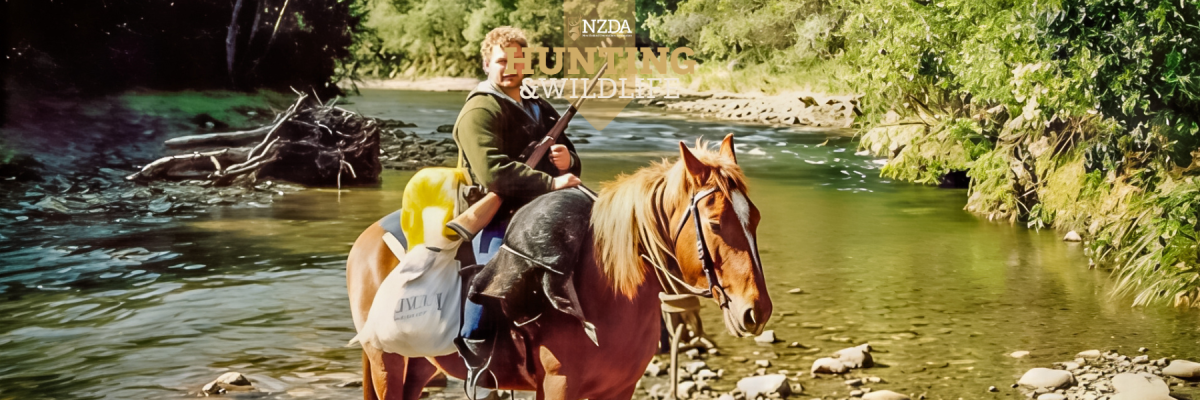
Sunny skies with a gentle northerly breeze was perfect for our four-hour ride upriver. However, our horses, Blue Girl and Big Brown, were less than enthusiastic about carrying their hunters along with laden pikau bags. Big Brown required the odd brush with a Buddleia twig along his rump to remind him about pace and not to dawdle. He was a big, strong horse, and I needed him to stand alongside a bank or log so I could climb up to mount him. Blue Girl was a few hands shorter, so my mate Pete could mount her with ease - like a real cowboy in the movies.
We planned to camp a way up the valley, about an hour down from the hut. My butt was getting a little sore when we found a nice campsite at the confluence of the main river and a reasonably sized side stream. We tethered the horses on the river flat where they picked through the remnants of fresh grass and ubiquitous deer droppings.
After setting up camp, Pete and I were quite keen for a siesta. It had been an early start, and the evening hunt was a few hours away. It wasn’t long before I drifted to sleep. Heavy raindrops thumping our nylon fly woke me from my rather nice midday snooze. Pete roused, and we both looked at each other through sleepy eyes. I tried to ignore this rapid change in weather, but raindrops began hitting the end of my sleeping bag. The tent fly bellowed like an inflated parachute as the gentle northerly turned into a gusty southerly. The rain got a lot worse, now heavy and driving sideways into our open-ended fly. “Bugga this,” Pete said, “How far away is the hut?” “About an hour upstream,” I replied. “Well, let’s pack up and head for the hut then.” We packed up camp, saddled the horses and loaded them up in record time, then began the hasty trot upriver in the now pouring rain; Big Brown leading and Blue Girl following close behind.
The rain was torrential, and it wasn’t long before side creeks turned into torrents, and the main river was turning brown and ugly-looking. The crossings were numerous. The horses appeared to be coping with the increased current and depth, but when I saw Blue Girl’s belly submerge and appear to struggle with her footing, my anxiety increased somewhat. I checked with Pete, who had a concerning look, but then I got the thumbs up. After a very wet trip, which turned into an hour and a half, we came around the last bend and saw the hut across the river. The hut was just above the confluence of the main stream and a major tributary. I looked at the final crossing, a little concerned. It looked deep, although hard to gauge, as the river was very dirty and its power looked overwhelming. I spurred Big Brown to the edge of the crossing. He looked at the river and leapt into the torrent, finding his footing against the force of the water and leapfrogging to the other side. He clawed his way up the opposite bank, his chest heaving and nearly unsaddling me with his wet horse shake.

I looked back to see Blue Girl follow, also leaping into the river, but being the shorter horse, she disappeared under with Pete fighting to stay in the saddle. Blue Girl lost her footing and began being swept down river toward a huge hole under a steep rock bluff, which churned brown water. Her head was the only thing visible, and Pete was submerged to his chest. Her eyes were wide open, and she had a look of absolute terror. Blue Girl was a gutsy horse, and she fought to find her footing, finally swimming out of the hole and clawing the bottom to find an exit on the opposite side. She leapt up onto the terrace with Pete still aboard both soaked, but alive. They walked over to us, Pete holding the reins with white knuckles and Blue Girl reunited with Big Brown. “That was stupid,” Pete said. “We could have both drowned.” He patted Blue Girl on the neck and said, “Thanks, girl, you saved my life.”
Since that event, I have become acutely aware of the dangers of New Zealand’s backcountry rivers. The experience with the horses frightened me, and over the years, I have felt an ingrained awareness and respect for rivers.
The purpose of this article is to share with you the principles of river safety and how to apply the thought and planning process every time you encounter a river to cross. It is important to know how to cross a river safely and, most importantly, to know when not to cross.
River characteristics
Generally, rivers drain large catchment areas, and therefore, when it rains, they can rise very quickly, thus greatly increasing the volume and power of the water. Most river crossing incidents occur in flooded rivers. Rivers can have a wide or narrow flow depending on the terrain. They can be shallow with fast-moving water, causing areas of rapids, or deep, slow-moving water that may conceal unforeseen hazards beneath. Regardless, rivers should never be underestimated and should always be respected.
Even the most placid-looking stream can become hazardous. Side streams often drop steeply where you can find waterfalls, gorges, areas of fast flowing water and deep cold pools. Navigating side streams should also be done with a wary and respectful approach.
River dynamics
‘Eddies’ are water that circles out of the main current and back up the river. They can occur at the riverbank or behind a big boulder in the middle of the river. The eddy line is where the water flowing downstream meets the water flowing upstream. Eddies can trap a person, making it very difficult to break free across the eddy line. It is wise to avoid eddies when crossing a river.

Obstacles are objects such as boulders or fallen trees that force the current around or under them. A person can easily be pinned, crushed against, or even forced down under an obstacle. Again, be wary of obstacles downstream and plan to avoid them.
Strainers are particularly hazardous. They are obstructions in the river where water can flow through, but a large object, such as a person, will be caught. Strainers have the potential to entrap people, and the force of the water makes it impossible to break free.
Several other river hazards exist, such as rapids, standing waves, buffer waves, and undercut riverbanks. It is important to be able to identify all of these, as they present their own unique dynamic when encountered. Water Safety NZ offers very good explanations of all types of river dynamics. It is worth researching these further.
Decision making
The decisions you make at the edge of the river, whether alone and pondering them in your own mind or discussing them with your group, may well determine a safe or potentially catastrophic outcome.
Do we cross?
Ask, can we cross safely at this spot? Assess the river, identifying potential hazards, the strength of the current, depth of the water, the nature of the river bottom, and whether the crossing is within your group's capability. You can throw a stick into the water, and if it carries faster than you can walk alongside, then the current is too swift for you to cross. If there is any doubt, look for an alternative crossing point. Check your map for an area where the river may well be wider and shallower with less current. If the river is swollen and dirty in colour, then do not cross. That may mean camping up and waiting for the river to drop.
Where do we cross?
Identify entry, exit and retreat points that are safe for you to enter and leave. Your retreat point may be downstream of your entry point, so ensure this is also safe. Choose a place to cross where the river is straight. Water will be deeper and flow faster on the outside of a river bend. Ideally, the river should be shallow, with slow-moving water and across a smooth gravel bed. Think carefully about crossing a river above thigh height of the shortest person in your party. The potential to be swept away increases with the depth of the river. If you are swept off your feet, is there an area downstream where you will be able to safely recover? Consider if this area may put you in more danger, and if so, find an alternative crossing.

Preparing to cross
It is wise to keep your boots on. They will provide stability and secure footing and protect your feet from injury. If you want to keep your hunting boots dry, wear some other closed-in footwear. Never cross in bare feet. Loose clothing, such as overtrousers or rainwear, will increase drag. It is best to remove these and carry them in your pack.
Make sure the contents of your pack are inside a sealed waterproof liner. You’ll want to keep the contents of your pack dry, especially your clothing and sleeping bag, which you may want to store in an additional dry bag inside the liner. If you do fall over, the sealed pack liner will trap air in your pack and provide you with an effective buoyancy aid.
Unfasten your chest straps and loosen the shoulder straps so you can slip out of your pack easily if necessary. Keep your waist belt done up, as this will stop the pack from riding up if you fall and need to pack float.
Communicate with the group so everyone is aware of the entry, exit, retreat and recovery points. Decide on the crossing method before entering the water. When carrying a firearm, you could sling it over your downstream shoulder, or it may be better to strap it upright to the side of your pack, depending on the difficulty of the crossing.
How to cross?
There are two crossing methods, solo and mutual support.
For the solo method, you’ll need a sturdy pole about two metres long that will support your weight. This pole will act as a third leg, providing you with additional stability when crossing. Hold the pole diagonally across your body and place it about one metre upstream. Place it firmly into the riverbed and lean weight on it. Keep your body side-on to the current.
Do not lift your feet or pole out of the water, but shuffle through the water, moving your feet and the pole one at a time. For each step and placement of the pole, make sure the footing is secure before the next movement. It is best to strap your rifle to the side of your pack, as you’ll need both hands to hold and move the pole effectively.
You will find the solo method increases your stability markedly compared to just shuffling across the river on your feet, and it’s a great idea to practise this method whenever you get the opportunity.
The mutual-support method provides support should someone lose their balance. It is worthwhile for the group to practise on dry land first before entering the river.
The strongest person should be positioned upstream to break the force of the water for the group. If there are more than two people, another strong person should be positioned on the downstream end to provide maximum stability there.
When carrying a pack, the chest strap should be released, the shoulder straps loosened, and the waist strap fastened. Each person can now reach around between the back and pack of the person beside them to grasp the hip belt or pack strap. This will keep the group bound together and provide mutual support and stability to cross the river. The upstream person should coordinate the crossing. If someone loses their footing, then support that person until they regain it.
If the group is not wearing packs, apply the same configuration and grasp your neighbour's hunting belt or clothing.
Retreating
Should you or any members of your group become uncomfortable about the crossing, it is best to decide to retreat before moving into the river.
Retreating using the solo method involves switching hands on your pole, leaving it anchored upstream, and moving yourself around the pole to face back toward your entry point.
To retreat as a group, the upstream person will give instructions to back out, watching feet placement carefully, or to initiate a caterpillar turn. To complete a caterpillar turn, the downstream person remains as an anchor while the upstream person turns until they are facing the person beside them. The group stays connected throughout the turn while the first person shuffles downstream, allowing the second person to turn. The downstream person finally turns on the spot once all group members have shuffled downstream past them, and the entire group is now facing back toward their entry point. The group can now move forward toward a predetermined exit point on the same side they started.
Recovery
Self rescue may be necessary if you lose your footing and end up in the water. This is why it’ s important to identify recovery exit points before you enter the river. If you are crossing solo and fall, then try leaning back onto your pack for flotation. Row with your arms and pedal your legs as if you were riding a bicycle. If you are feet first, you can fend off obstacles as you pedal downstream toward your exit. If you are headfirst, then your pack will protect your head from hitting any objects.
If you are crossing using mutual support and the group falls, try staying together and leaning backwards onto your packs. Use the same bicycle pedalling and arm rowing to propel the group toward the exit.
If the group separates, then apply the same method as you would crossing solo. If your pack compromises your safety, then slip out of it, but don’t let it go, as this risks losing all your gear and your flotation aid downriver. Ride your pack on your front, kicking to propel yourself until you reach the bank. Your pack will be heavy, so move it onto shore by lifting and pushing it forward until it is well out of the water. Only stand up when you and your pack are completely out of the river.
After crossing
Many New Zealand rivers can be extremely cold, especially in winter. Monitoring your own and your group's condition is really important. Warm up by having a hot drink, changing into dry clothes, and resting. It is also a good idea to check the contents of your pack to ensure the liner has remained sealed and your gear is still dry.
Finally
Rivers bring a special beauty to the New Zealand outdoors. They offer hunters convenient access routes and favourable places to hunt. However, they always need to be treated with respect. A gentle flow can turn into a raging torrent within a few minutes. Keep a watch on the weather and plan your trip to account for crossing rivers. There is reliable information about river safety, both on the internet and in publications. Prior research and knowledge about rivers and river safety will better prepare you, and with practise, you’ll feel a lot more confident and capable when you approach a river to cross.
One year after the incident with the horses, Pete and I were back riding up the same river. Unfortunately, we were told Blue Girl had passed away a couple of months earlier and not far away from where she had nearly been swept fatally down river. While tethered, Blue Girl had slipped down a bank and broken her leg. She was put down and buried where she fell. As we rode up the river in the sunshine, me on Big Brown and Pete on his brother, Big Boy, we came across Blue Girl’s grave at the base of the bank where she slipped. It wasn’t hard to miss as there were four hooves displaying rusted horseshoes sticking straight up toward the sky. It looked a little amusing; the grave was obviously not quite deep enough, which was understandable since it was dug with a shovel. We both gave Blue Girl a kind thought and carried on upriver.
Read Hunting & Wildlife Magazine
NZDA members receive an electronic version by email, and can access it on the NZDA app. Subscriptions and physical copies can be purchased online. Visit the NZDA Shop at www.nzda.shop
Missed an issue?
We make our older editions free to read online. Browse the back catalogue here.
Write for Hunting and Wildlife