
Hunting and Wildlife Magazine - Issue 233 - Winter 2026
Words by: Courtney Hickton
There are hunts you plan meticulously, and then there are hunts that take on a life of their own. Our five-day expedition in the Willberg Block of the Adams Wilderness Area on the West Coast was the latter. What began as a straightforward prize hunt for two of our most fortunate members quickly became a challenge. It was a humbling and utterly stunning hunt in some of New Zealand’s most remote and demanding terrain.
Every year, the New Zealand Deerstalkers Association runs a spot prize for our members who renew their membership. Winners typically get a substantial gear package and a tahr hunt. Simon, a Wellington-based IT professional and Land Search and Rescue volunteer, was the 2025 winner. Life had other plans, and personal circumstances meant his hunt was deferred. In 2026, Simon’s trip was combined with that of Richard, this year’s winner – an Aucklander who works in drilling and sports the most impressive beard. We took to calling him Mountain Zeus, and it suited him perfectly. Joining the party were Gwyn Thurlow, our CEO, and me, coming along as photographer.
Richard and I flew down to Wellington to join Simon and Gwyn, and from there the adventure began in earnest. Before we headed off for the South Island, Richard received his prize at the National Office: a full gear package that he promptly packed up for the trip. The three lads jumped on the Interislander ferry across to Picton. At the same time, I boarded a Sounds Air flight – only for miserable weather to divert me to Blenheim, where I waited until ten o’clock at night for the rest of the party to arrive by car. From there, we drove through the night to reach our landing site by morning, a helicopter pad out near Whataroa on the West Coast.
Morning brought low cloud. We gathered at the helipad car park from eight o’clock, met a couple of other tahr hunters in the same boat as us, and waited. By just after ten, the cloud began to lift, and we got the green light. We were the first flight in.
One helicopter, two loads. Gwyn and Simon went first, dropping into the Lower Willberg site while we made our way over in the second flight. For Richard, this was his first time in a helicopter, and he absolutely loved every second of it.
The Willberg Block is a tahr ballot area – one of several special permits that grant hunters the right to land a helicopter within the Adams Wilderness Zone. Without that ballot, this country is essentially inaccessible. There are no tracks in, and no roads nearby. It is the definition of remote, and the landscape makes no apologies for it.
Day One – High Bulls, High Water
Our campsite at the Lower Willberg was, by alpine standards, rather good. Previous hunting parties had even left behind a bag of coal which was a welcome bonus. Gwyn’s MIA hot tent served as our communal hub, with each of us sleeping in our own personal tent pitched around it. Everything fitted. Just.
The weather was drizzly, and the river was running high – our first real obstacle. It effectively cut us off from exploring the far side of the valley. We glassed from where we could and saw nothing in the immediate area: no bulls, no nannies, and no sign. I later caught movement on a distant south-facing slope – a thick black silhouette sidling across the mountainside. Even from that distance, the bulk of a bull tahr is unmistakable. He was mooching along on his own, well across the river and high up, far out of any realistic range. We watched him until he disappeared into the guts of the mountain.
We explored both up and down the river, finding ourselves bluffed out at every crossing. The boulders were relentless, the river high and fast. We were, however, treated to a blue duck paddling serenely in the water. Gwyn had his long lens out in an instant. By the end of the day, it was clear that we needed the river to come down, and we needed to go light. The decision was made to spike camp – pack minimal gear, push hard and push far, and chase whatever opportunities the block might give us.

Day 2 – Going Light
Blue sky, sunshine, and big packs were today's theme. As predicted, the river had dropped, and we were able to cross. We began making real progress up the valley, glassing as we went. There had been significant rain just before we flew in, and whatever snow might have been sitting on the peaks had been washed away. The consequence was significant: without snow to push them down, the tahr were impossibly high, sitting right on the summits of terrain that was, in most places, simply not climbable as a group of four with safety front of mind.
By five o’clock, we’d found our spike camp – a term I use generously. The tents were essentially balanced on clumps of tussock clinging to a steep hillside. It was neither flat nor comfortable. But the views were great and spirits were high. We pooled our freeze-dried rations, put together some dinner, and settled in as weka ferreted noisily around the camp through the night.
Day 3 – Pushing On
We woke to frost. An inch-thick dinner plate of ice had formed on the fly between the tents overnight. Hot drinks came first, then we packed up and pushed on, intent on gaining altitude. The terrain was as vertical as ever. We climbed hard through the morning before reaching a point where a collective, sensible decision was made – we had gone far enough. You can’t push beyond your limits in this kind of country. That’s when things go wrong. We made our peace with it over a coffee, glassed for a while longer, and turned back.
By midday, we had packed camp and were on the move again. We zigzagged the river crossings with Gwyn leading the way, helping each other across. The sun was generous and the scenery epic.
Just before two o’clock, the day changed pace. A bull was spotted low down. A genuinely shootable, mature animal – the first we’d seen at any reachable elevation all trip. The excitement was immediate. Richard set up, dialled in, and Gwyn ranged the distance. Everything was ready. The shot went off.
“Too high.”
A reload. Another shot.
“Miles too high. Something’s wrong.”
The bull, unbothered about where the shots were coming from but certain he wanted no part of it, climbed. With the speed and agility that only a tahr on its home turf can demonstrate, he scaled a near-vertical rock face and vanished into the guts of the mountain. Gone.
Richard had been adjusting his scope during earlier glassing and hadn’t reset it to zero. When he dialled in for this bull, he was adding elevation on top of an existing adjustment, sending both shots sailing well above the animal. It’s a mistake that nearly all of us have made at some point or another. Mountain Zeus took it on the chin. That bull at least gets to live and grow a little larger.
Come five o’clock, clouds settled over the peaks, and visibility dropped away. We found a second spike camp that was almost as rocky and tilted. Gwyn and Simon pushed off for one final evening glass before dark. After finding a good spot to sit, Gwyn soon had eyes on another bull. Simon settled in, took his time, and squeezed the trigger.
The impact was clean and definitive, that unmistakable reaction of a well-hit animal. They watched the bull buckle and come to rest. With little light left, recovery would wait until morning. Back at camp, under a sky absolutely carpeted in stars and the full sweep of the Milky Way, spirits were as high as they’d been all trip. Dinner that night featured a Real Meal pudding. It did not disappoint.

Day Four – Simon’s Bull
Tahr country has a habit of making you work for everything, and recovering Simon’s bull was no exception. It took us until nearly midday to reach him. He wasn’t the oldest animal in the block, but he was Simon’s first recovered bull tahr, and that is something that cannot be measured in age or mass. There was a real celebration as we came up to him. Simon is getting the skin tanned and the head cleaned up, and you could see from the look on his face that this animal means a great deal to him.
While Gwyn and Simon worked on the skin, Richard and I glassed our surroundings. From our elevated position, we could actually see the Upper Willberg landing site below us – we’d well and truly pushed up and through the block.
Later that afternoon, Gwyn and I climbed higher to glass into the next basin. This is one of the great pleasures of tahr country, gaining a ridgeline and suddenly seeing a whole new world open up beyond it. We settled in to glass through until last light.
Cloud began to build from the valley below, eventually swallowing the surrounding peaks. For a time, visibility was reduced to little more than the ridge we sat on. Then, just as quickly, the cloud sank back down the valley, settling into a thick blanket below us and revealing the tops once more. Where another hunter might have packed away the binoculars and headed back to camp, we sat and watched an extra hour of prime glassing time materialise from what had looked like a closing day. With the sun hitting the jagged summits at that low evening angle, it was the kind of scene that reminds you exactly why you love coming to places like this.
Of course, the bulls were on the tops – beautiful but unreachable. We watched them for a while, then dashed back to camp.
Day Five – Richard’s Redemption
By day five, we’d decided we had exhausted the upper end of the block, packed up and set off back to base. Gwyn and Richard were moving ahead of Simon and me, with Simon carrying the welcome but considerable weight of his bull’s head and skin. The pair ahead spotted a bull on the move.
They moved quickly up onto a spur, sidled around the back to stay out of sight, and climbed to a shooting position. Simon and I tried to catch up without missing the action. The spotting scope went onto the bull. A good, mature animal - the real deal. Gwyn ranged him, and Richard set up his rifle.
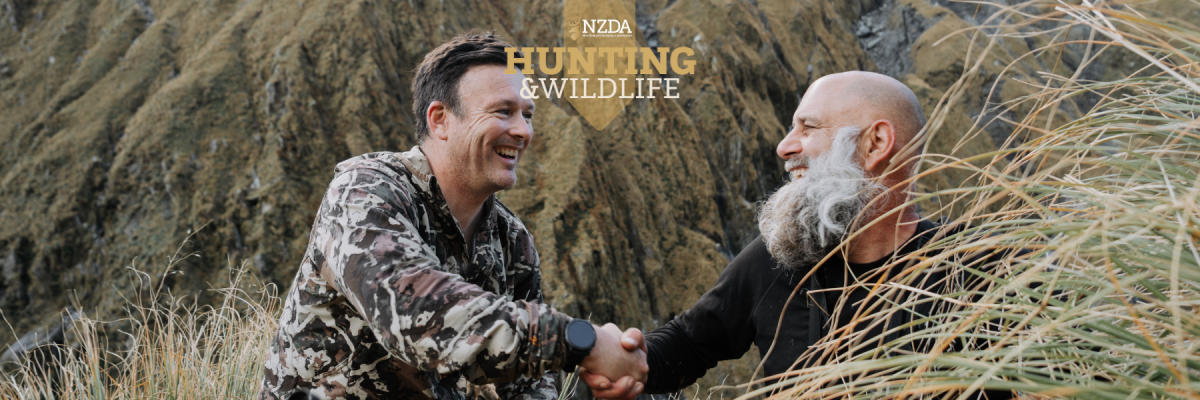
This time, everything came together. The bull was standing on the front face of a peak across from the spur. The shot was uphill and clean. Richard squeezed the trigger, and the bull dropped. Handshakes took place in a moment of genuine joy; Richard had shot his first bull tahr.
Then came the difficult part. The terrain between us and the bull, which had looked navigable, revealed itself to be anything but. The face was sheer; there was no way around the back as we’d hoped, and attempting a recovery would have meant taking on real risk for no safe route. The decision was made not to push it. Richard’s bull would stay on the mountain.
It was a gutting reality, and nobody felt it more than Richard. Had there been snow on the mountain, as there might normally be at this time of year, we’d have almost certainly been able to reach him. That same extraordinary week of bluebird weather that made every day a pleasure to be out in had, in its own way, made the block harder to hunt and the recovery impossible. However, Richard shot his first bull and climbed mountains, which in itself is a success.