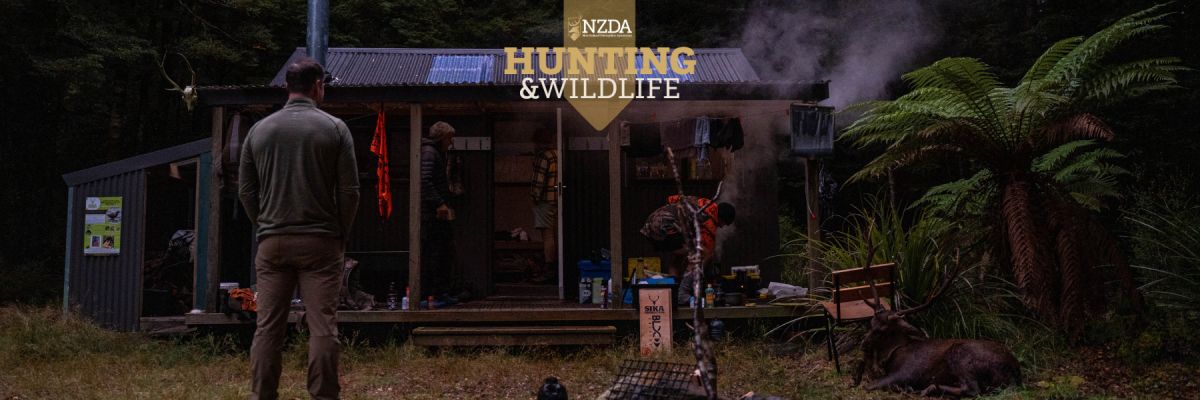
Hunting and Wildlife Magazine - Issue 229 - Winter 2025
Words By: Dr. Robert Kroger
Cam Speedy was sitting under a 200-year-old beech tree. He had just finished telling me a poem about the Kaimanawa. He almost recited it into the camera, but there was a heartbeat to the words – coming out in a slow, methodical, heartfelt way. I had only experienced this Jurassic-esque landscape for the last four days, but I could already understand those words drifting on the mist that moved ethereally through the old-growth forest.

The Sika Foundation may not be known to the world, but it’s an amazing organisation, championed by a set of amazing volunteers, arguably implementing some of the highest standards of hunter-led conservation in the world. Steered by science and landscape condition, emphasising wildlife management and the need for it, the Sika Foundation has taken it upon itself to steward a landscape called the Kaimanawas. Why? I think that’s a very appropriate question to ask. Why would hunters, of their own volition, volunteer their time to reduce the resource that they cherish - for the conservation of native fauna and flora? The answer is quite simple. Because it’s the right thing to do.
The primary mission of the team at the Sika Foundation is the sika deer herd. Sika deer were introduced to New Zealand for hunting, with the first release near Oamaru in the South Island in 1885. However, this initial attempt did not lead to a successful, established population. A subsequent, more successful, release was made in the Kaimanawa Mountains of the North Island in 1905, with six sika deer from the Woburn Abbey herd in England. Given the lack of predators and a native flora that is essentially a smorgasbord for browsers and grazers, sika flourished. They have done too well, resulting in ecosystem degradation in areas, hence the critical need for management. Management is critical for two elements, which are not mutually exclusive. A pruning of the herd to ensure that the ecosystem can handle the number of animals on it not only has significant conservation benefits, but also will result in high quality animals available for hunters in the future. This is from a weight/condition perspective (i.e., vegetation resources increase in abundance and nutrition because of a reduction in herd density), but also from an antler quality perspective due to a specific management of the herd. Both management elements will yield a future healthy herd condition and antler quality through continued management.
However, the Sika Foundation's work extends well beyond the animal that their organisation is named after. The Foundation's work is all-encompassing in the Kaimanawa’s for the benefit of all New Zealanders and the world. The Kaimanawa’s are public ground. Anyone in New Zealand can access them, walk in and enjoy them. Like most governments worldwide, there isn’t enough funding to manage the land the government owns, hence relying on conservation organisations and volunteers to move that effort forward. The Sika Foundation looks after trails, keeping them open, and has work weekends for maintaining and upgrading the public huts that are a keystone feature of the New Zealand public land landscape. But beyond all of this, the Sika Foundation’s greatest effort is their work in resurrecting and creating a thriving Whio Duck population deep in the Kaimanawa’s.

Their work leads to unlikely places in small North Island towns, like Taupō. Sika venison, brought off the mountain by generous donations from companies like Bergara International (yes, a foreign company investing in New Zealand from halfway around the world), allows the Sika Foundation to recover the resource that is being managed and reduced and utilise it to the benefit of those that need it the most - people. You see, like the back streets of Taupō one can find anywhere in the world, people are struggling, and essentially don’t have the means to access protein, whether that’s due to scarcity or they simply can’t afford it. And in this scenario, hunters and an abundant resource that needs to be managed can be used for the greater good of society. The Sika Foundation provides thousands of kilograms of meat into the food pantry system in Taupō, helping the community, simply through the act of balancing the ecosystem.
Lastly, while pruning the herd, providing venison to the folks who need it, and maintaining trails and huts for the general public of the world, the volunteers of the Sika Foundation are playing one more vital role in the backcountry ecosystems in New Zealand, which is predator control. New Zealand has a storied history of invasive predators – stoats, weasels, hedgehogs, mice, rats, and feral cats. All those predators have laid waste to the incredible faunal biodiversity of New Zealand, decimating it to the point of extinction in places. One species that gets hammered the most, due to the overlap of habitat niches with predators, is the native Whio. Due to its life history strategy of nesting in the river corridors and banks of streams - the very same corridors the predators are traversing - there is inherent conflict. The Sika Foundation has taken it upon itself to mitigate the conflict and lay down traplines to protect, sustain, and increase the abundance of Whio. It may seem blasé to say ‘lay down traplines’, but we are talking 200+ traps in a line, in some of the most inhospitable territory imaginable, under all weather conditions, 24 hours a day, 7 days a week, 365 days a year. A constant vigilance to protect New Zealand’s fauna… all done because it’s the right thing to do.

If you truly want to understand who the Sika Foundation is, if you truly want to understand their ‘nourished heart’, search “Kaimanawa Blood Origins” on YouTube or click the QR code associated with this article and watch it. After you watch it, I want you to use that knowledge – tell someone about it, talk about it at your dinner table, and if you live within any reasonable distance of Taupō in the North Island, volunteer your time with the Sika Foundation.
Read Hunting & Wildlife Magazine
NZDA members receive an electronic version by email, and can access it on the NZDA app. Subscriptions and physical copies can be purchased online. Visit the NZDA Shop at www.nzda.shop
Missed an issue?
We make our older editions free to read online. Browse the back catalogue here.
Write for Hunting and Wildlife